Draw Mask Final Cut Pro X Download Mac
- Adobe Premiere Pro User Guide
- Beta releases
- Getting started
- Hardware and operating organization requirements
- Creating projects
- Workspaces and workflows
- Capturing and importing
- Capturing
- Importing
- Importing from Avid or Concluding Cut
- Supported file formats
- Digitizing analog video
- Working with timecode
- Capturing
- Editing
- Sequences
- Video
- Audio
- Overview of audio in Premiere Pro
- Audio Runway Mixer
- Adjusting volume levels
- Editing, repairing and improving audio using Essential Sound panel
- Automatically duck audio
- Remix audio
- Monitor clip volume and pan using Audio Clip Mixer
- Audio balancing and panning
- Advanced Sound - Submixes, downmixing, and routing
- Audio effects and transitions
- Working with audio transitions
- Use effects to audio
- Measure audio using the Loudness Radar consequence
- Recording audio mixes
- Editing audio in the timeline
- Audio aqueduct mapping in Premiere Pro
- Use Adobe Stock audio in Premiere Pro
- Overview of audio in Premiere Pro
- Avant-garde editing
- All-time Practices
- Video Furnishings and Transitions
- Overview of video effects and transitions
- Effects
- Transitions
- Graphics, Titles, and Animation
- Graphics and titles
- Overview of the Essential Graphics panel
- Create a title
- Create a shape
- Check spelling and Find and Replace
- Utilise text gradients in Premiere Pro
- Add together Responsive Design features to your graphics
- Use Motion Graphics templates for titles
- Replace images or videos in Move Graphics templates
- Use data-driven Motion Graphics templates
- Best Practices: Faster graphics workflows
- Working with captions
- Speech to Text
- Speech to Text in Premiere Pro | FAQ
- Upgrade Legacy titles to Source Graphics
- Overview of the Essential Graphics panel
- Animation and Keyframing
- Graphics and titles
- Compositing
- Color Correction and Grading
- Overview: Color workflows in Premiere Pro
- Get creative with colour using Lumetri looks
- Adjust colour using RGB and Hue Saturation Curves
- Correct and match colors betwixt shots
- Using HSL Secondary controls in the Lumetri Color console
- Create vignettes
- Looks and LUTs
- Lumetri scopes
- Display Colour Management
- HDR for broadcasters
- Enable DirectX HDR support
- Exporting media
- Collaboration
- Working with other Adobe applications
- Organizing and Managing Assets
- Improving Functioning and Troubleshooting
- Monitoring Assets and Offline Media
Use Premiere Pro's masking tools to apply effects to a specific part of a frame in your video. Acquire to apply a mask, and then track it as it moves across the frame.
Masking in Premiere Pro
Masks let you define a specific surface area in a clip that you desire to mistiness, cover, highlight, utilize effects, or color-correct. You tin create and modify dissimilar shaped masks, like an Ellipse or a Rectangle. Or, you can draw free-form Bezier shapes using the Pen tool.
Create masks using shapes
You tin use the Ellipse shape tool to create a circular or ellipse-shaped mask, or a Rectangle shape tool to create a iv-sided polygon.


-
In the Timeline panel, select the clip you desire to mask.
-
From the Furnishings console, select the consequence that y'all want to utilize to the clip.
For example, if you desire to use the Mosaic effect, select Video Effects > Stylize > Mosaic.
-
Apply the selected effect to a clip by dragging the effect from the Furnishings panel to the clip in the Timeline panel. Alternatively, select the clip and double-click an effect in the Effects console to apply it.
For more data on applying an effect, see Apply furnishings to clips.

Add mosaic outcome to a clip -

Ellipse, rectangle, pen tool Open the Effect Controls panel to meet the effect backdrop. Click the drop-down arrow to reveal the controls.
Yous can create an ellipse or rectangle. Utilize the Pen tool to create free form shapes.
Y'all can specify values to adapt a mask using theEffect Controls panel. The controls change depending on your pick. For more data, seeConform mask settings.
-
Click the Ellipse shape tool to create an Ellipse-shaped mask or click the Rectangle shape tool to create a rectangle-shaped mask.
The shape mask appears in the prune displayed in the Program Monitor, and the effect is constrained within the masked surface area.

Ellipse -
You lot can now customize the size and shape of the mask using the Consequence Controls panel. For more information on editing your mask, run intoSuit mask settings.

Create a mask using the Ellipse tool


Y'all can apply the same effect multiple times past using different settings each time.
 Of import notes
- Premiere Pro does not save masks every bit furnishings presets.
- Masking is disabled for the Warp Stabilizer effect. The mask shape controls practise non appear for the Warp Stabilizer effect in the Effect Controls Panel.
You tin create free-form shapes using the Pen tool. The Pen Tool lets you freely draw complex mask shapes around objects.
Select the Pen tool from the Issue Controls panel. Draw direct on the clip in the Program Monitor.
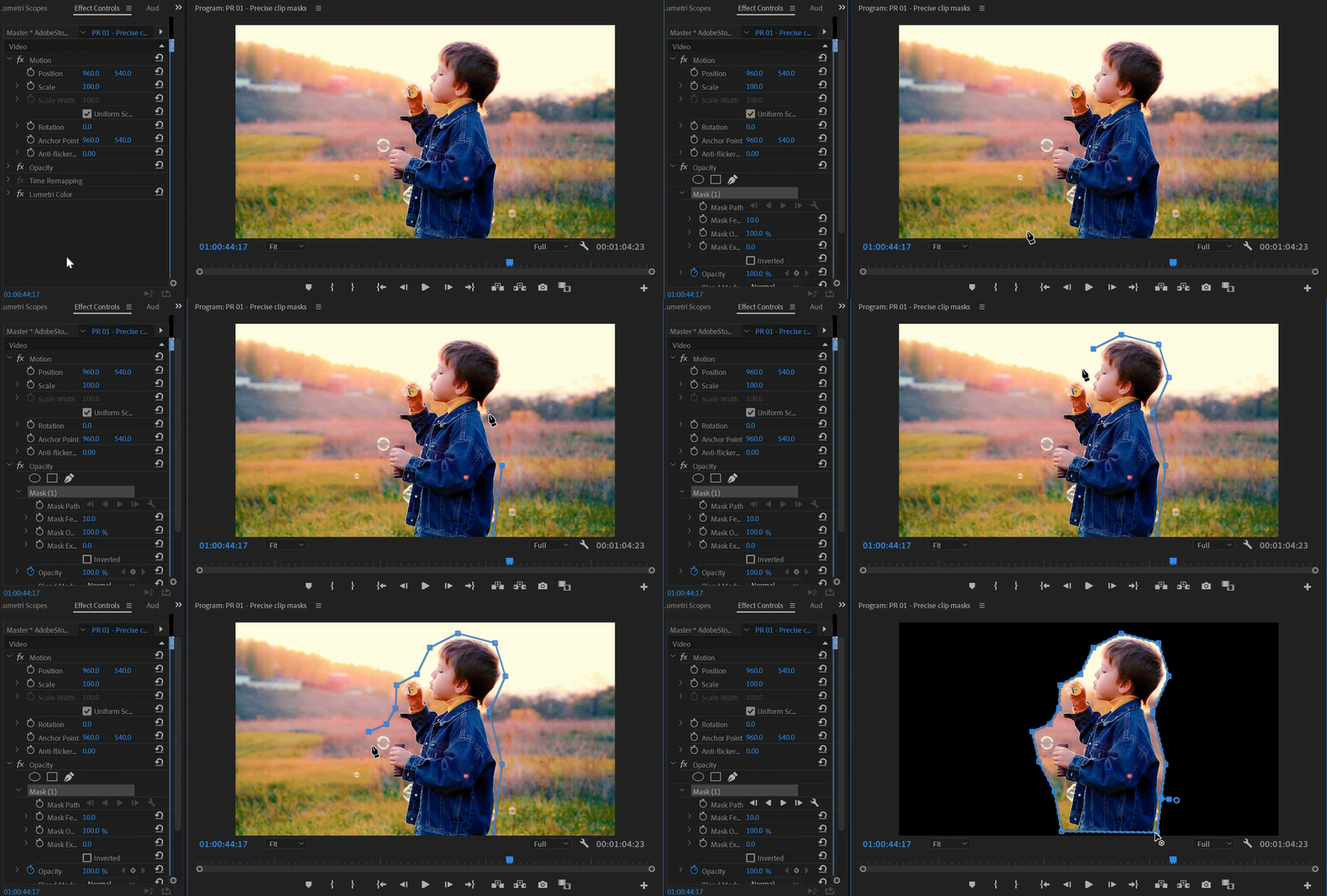
You can create different shapes past drawing direct lines and curved segments. To describe polish curves, y'all tin can draw Bezier path segments that provide you greater control over the shape of the mask.
The simplest path that you lot can draw with the Pen tool is a straight line with ii vertex points. By continuing to click, y'all create a path fabricated of straight-line segments continued by vertex points. This is a linear mask.
A linear mask is always a polygon with joined by hard angles. Linear command points are also known as corner points.

-
Position the Pen tool where you want the straight segment to brainstorm, and click to ascertain the offset vertex signal (practice non drag).
The showtime segment you draw is not visible until you click a second vertex indicate.
-
Click once more where yous want the segment to end.
-
Continue clicking to set vertex points for boosted direct segments.
-
To close the path with a linear mask, Alt+click (Windows) or Option+click (macOS) over the first vertex point.
You create a curved path segment past dragging direction lines using the Pen tool. The length and management of the direction lines determine the shape of the curve.
To create Bezier shapes, you catechumen a vertex point on a mask to a Bezier point by pressing the Alt key while placing the cursor over the vertex point. The cursor becomes an inverted "V" shape  . Then, click and release the arrow.
Bezier handles provide two-directional controls that allow you lot to change the curve of the line segment between the handle and the next point on either side.

A. Two-directional Bezier handles to control the shape of the curveB. Bezier mask points
-
Place the Pen tool where you lot want the curve to begin, and concord the mouse button down. A vertex appears, and the Pen tool pointer changes to an arrowhead.
-
Drag to modify the length and direction of both direction lines for a vertex, and then release the mouse button.
A. Placing the Pen tool
B. Starting to drag (mouse button pressed)
C. Dragging to extend management lines
Cartoon the first vertex in a curved path -
Place the Pen tool where you lot want the curved segment to cease, and do i of the following:
- To create a C-shaped bend, elevate in the direction opposite from the direction that you dragged the previous direction line, so release the mouse button.
A. Starting to drag
B. Dragging abroad from previous direction line, creating a C curve
C. Result afterward releasing mouse button
Cartoon the 2nd vertex in a curved path - To create an Southward-shaped curve, drag in the same direction as the previous direction line, and then release the mouse button.
A. Starting to elevate
B. Dragging in same direction every bit previous direction line, creating an S curve
C. Result subsequently releasing mouse button Drawing an S curve -
Keep dragging the Pen tool from different locations to create a serial of smoothen curves.


You lot tin can create perfect angles using the Pen tool. To create a perfect bending, do one of the following:
- Shift + click to draw perfect 0°, 45°, 90° angles.
- Shift+ drag on an existing Linear signal to motion it around at 0°, 45°, xc° angles.
- Shift + click to describe a new bezier point to create a curve with handles constrained to 0°, 45°, 90° angles.
- Shift + drag on existing Bezier control handles to adjust them at 0°, 45°, ninety° angles.
- Opt + Shift + click and elevate breaks the bezier into ii curves while constraining the one you clicked on to 45° increments.
Modifying and moving masks
The vertex points on a mask allow you easily manage the shape, size, and rotation of a mask.
Modify the shape, size, and rotation of a mask

To alter the shape of a mask, drag a mask handle.

To change the shape of an ellipse mask to a polygon, press Alt and click any of the vertices of the ellipse.

To resize a mask, place your cursor just outside a vertex and press Shift (cursor becomes a double-sided arrow ), so drag the cursor.

To rotate the mask, place your cursor just outside a vertex (cursor becomes a curved double-sided arrow ), and so drag.
Motion, add together, or remove a vertex

To motility a vertex, drag the vertex with the Selection tool. Annotation that while dragging an ellipse-shaped mask, the ellipse shape is not maintained.

To add a vertex, identify your cursor over a mask edge while pressing Ctrl (Windows) or Cmd (macOS). The cursor changes to a pen shape with a "+" sign .
.

To remove a vertex, place your cursor over the point while pressing Ctrl (Windows) or Cmd (macOS). The cursor changes to a pen shape with a minus sign .
.
Other important commands and keyboard shortcuts
- Apply the arrow keys on your keyboard to nudge a selected control betoken by a distance of ane unit of measurement.
- Press Shift and use the arrow keys to nudge a selected control point by a distance of five units.
- To deselect all the selected control points, click outside a currently agile mask.
- To disable direct manipulation of a mask, click outside the mask. Or deselect the prune in the sequence.
- To delete a mask, select the mask in the Effect Controls Panel and printing Delete on your keyboard.
Adjust mask settings
You tin specify values to adjust a mask using the Event Controls panel. You tin can feather the mask, expand the mask, change the opacity, or invert the mask to stylise your video.

Apply mask feathering

To feather a mask, specify aMask Plume value. The feathering guide appears around the mask as a dashed line. Drag the handle away from the feathering guide to increment the feathering, or toward the feathering guide to subtract the feathering.
The mask feather handle lets you control the amount of feathering straight on the mask outline in the Program Monitor.
Adjust mask opacity

When opacity is applied to a mask it volition change the opacity of the footage you have cropped out.
To adjust the opacity of a mask, specify a Mask Opacity value. The slider controls the mask opacity. At a value of 100, the mask is opaque and blocks out any underlying area of the layer. As you lower the opacity, more of the area nether the mask becomes visible.
Accommodate mask expansion

To expand a mask, specify aMask Expansion value. Positive values movement the borders outward, and negative values move it inward. You can also drag the handle away from the expansion guide to expand the mask area, or toward the expansion guide to contract the mask area.
Invert mask choice

Select the Inverted check box to reverse the masked and unmasked areas.
You can protect areas that you desire to get out as-is by masking it, and select the Inverted check box to utilise effects to the unmasked areas.
Copy and paste masks
You can easily copy and paste masks betwixt clips or between furnishings.
Re-create and paste effects with masks betwixt clips
When yous copy and paste an effect containing masks, the pasted issue has the same masks applied.
- In the Timeline panel, select the clip containing the effect with masks.
- In the Effect Controls panel, select the effect to copy.
- Select Edit > Copy. Or use the keyboard shortcut Ctrl+C (Windows) or Cmd+C (Mac OS).
- Select some other prune in the Timeline to which y'all want to paste the mask.
- Select Edit > Paste. Or use the keyboard shortcut Ctrl+Five (Windows) or Cmd+Five (Mac OS).
Copy and paste masks between furnishings
- In the Effect Controls panel, click the triangle to expand the event to reveal the applied masks.
- Select the mask to re-create.
- Select Edit > Copy. Or use the keyboard shortcut Ctrl+C (Windows) or Cmd+C (Mac Bone).
- Select another effect in the Issue Controls console to which you want to paste the mask.
- Choose Edit > Paste. Or utilise the keyboard shortcut Ctrl+V (Windows) or Cmd+Five (Mac Os).
You can copy and paste just one mask at a time.
Mask tracking in Premiere Pro
When y'all apply a mask to an object, Premiere Pro can let the mask automatically follow the object as information technology moves from one frame to another. For instance, after blurring a confront using a shape mask, Premiere Pro can automatically track the movements of the masked face from frame to frame as the person moves.
When a mask is selected, the Effect Controls console displays controls for tracking the mask frontwards or backward. Yous can choose to rail the mask either ane frame at a fourth dimension or until the end of the sequence.
Click the wrench icon to modify how masks are tracked. You can select from a few choices to provide the about effective tracking:
Position
Tracks just the mask position from frame to frame
Position And Rotation
Tracks the mask position while changing the rotation as required per frame
Position, Scale, And Rotation
Tracks the mask position while automatically scaling and rotating equally the frame moves
You lot can find the choice that works best for your clip by trial. Select ane of these options, and if it doesn't work well, undo, and try another one.
To utilize the more advanced tracking features bachelor in Later Effects, transport your sequence to After Effects using the Dynamic Link feature. For more than information, come across Mask Tracking in After Effects.
Speed upward mask tracking
Mask tracking in Premiere Pro is faster when Alive Preview is disabled (the default selection). If for some reason, Live Preview is enabled, you can disable it using the following process.
-
In the Timeline panel, select the clip containing the effect with masks.
-
To preview the changes in the runway, click the mask wrench icon
and select preview from the drop-down list.
Mask preview -
To disable live preview, click the mask wrench icon
 and deselect preview from the drop-downward listing.
Disable alive preview


In addition, Premiere Pro has in-built features that optimize mask tracking:
For clips with a height greater than 1080, Premiere Pro scales the frame to 1080 before calculating the track. As well, Premiere Pro uses Low Quality renders to speed upwards the process of mask tracking.
Video tutorial

How to blur a moving face up with masking and tracking
In this 5-min video tutorial, learn how to apply a feathered mask to protect a person's identity and and then track that mask as information technology moves across the frame in a scene.
The tutorial provides you sample files to effort out the feature for yourself.
Draw Mask Final Cut Pro X Download Mac
Posted by: silviamakee1954.blogspot.com


0 Komentar
Post a Comment